 25°C


Fastest-Growing Business Sectors in the Dominican Republic
The Dominican Republic’s strongest business expansion opportunities span financial services, transportation and logistics, agriculture, tourism, export manufacturing, and energy. Official economic data for 2025 show that financial services recorded the fastest real output growth among major service industries, while merchandise exports reached a record US$14.65 billion and foreign direct investment totaled approximately US$5.03 billion. Comparing these indicators reveals which industries are expanding, where investment is flowing, and which opportunities deserve closer examination.


The Dominican Republic has developed a diversified economy that connects Caribbean tourism, export-oriented manufacturing, agriculture, construction, financial services, and international trade. These industries do not grow at the same pace, and their prospects cannot be assessed using a single statistic.
Real economic output measures changes in production after accounting for price effects. Export growth indicates demand from international markets, while foreign direct investment reveals where investors are allocating capital. Employment, business credit, and customer demand provide additional evidence of whether expansion is translating into commercial activity.
The latest complete annual comparison used in this guide covers 2024 and 2025, with selected 2026 indicators included where official data are available. The Central Bank of the Dominican Republic provides the principal source for sectoral economic growth, while ProDominicana, the country’s export and investment promotion agency, supplies complementary export and investment figures.
The results show an important distinction: the fastest-growing industries by real output are not necessarily the industries receiving the most investment or generating the largest export increases. Financial services, for example, recorded strong real growth in 2025, while tourism and energy attracted substantial shares of foreign investment. Export manufacturing and agriculture stand out for their international sales, whereas construction presents a more mixed picture.
This comparison ranks industries according to the breadth and strength of their measurable expansion signals. It is not an official government ranking, nor does it imply that every company within a growing industry will be profitable.
How the Fastest-Growing Industries Are Ranked
The comparison uses five indicators, prioritizing measures that can be compared across sectors and distinguishing actual performance from investment potential.
- Real GDP growth: The annual change in inflation-adjusted production reported by the Central Bank for 2025.
- Exports: Changes in the value of goods sold internationally, including free-zone and agricultural exports.
- Foreign direct investment: The amount and distribution of foreign capital entering the Dominican Republic.
- Employment: Available evidence of job creation, particularly in export-oriented manufacturing.
- Demand and financing: Visitor arrivals, business credit, and other indicators that help establish whether commercial activity is expanding.
Real GDP growth is the main basis for comparing sectoral performance. Export and investment indicators are used to identify industries with additional evidence of expansion or substantial capital commitments. Where a sector has strong investment but weak recent production growth, that distinction is made explicit.
The principal annual figures are preliminary and may be revised by the Central Bank. Export values are nominal, meaning that changes can reflect prices as well as quantities. Investment flows are not equivalent to operating revenue, and credit growth does not necessarily translate into completed projects or higher productivity.
The Dominican Republic’s Economic Growth in 2025
The Dominican Republic’s real GDP grew by 2.1% in 2025, compared with 5.0% in 2024, according to the Central Bank’s annual economic report. Growth therefore slowed considerably at the national level, even though several industries continued to expand.
| Economic activity | Real growth in 2024 | Real growth in 2025 |
|---|---|---|
| Financial services | 8.1% | 7.5% |
| Mining and quarrying | -5.2% | 4.6% |
| Transportation and storage | 5.7% | 4.1% |
| Agriculture and livestock | 4.9% | 3.7% |
| Hotels, bars, and restaurants | 9.5% | 3.5% |
| Real estate and rental activities | 3.8% | 3.1% |
| Energy and water | 7.0% | 2.8% |
| Commerce | 5.6% | 2.1% |
| Free-zone manufacturing | 4.3% | 1.8% |
| Local manufacturing | 4.3% | 1.4% |
| Construction | 2.1% | -1.8% |
Source: Central Bank of the Dominican Republic, Economic Report, January–December 2025.
These figures show why a cross-sector comparison matters. Financial services maintained strong growth, transportation and storage expanded at a solid pace, and agriculture and tourism continued to grow. Manufacturing also expanded in real terms, but at a more moderate rate than in 2024. Construction contracted, despite receiving additional bank financing.
Mining deserves separate consideration because its 4.6% increase followed a 5.2% contraction in 2024. Its rebound is measurable, but the comparison does not establish a continuous expansion trend. Likewise, a high growth rate in a single year does not automatically make an industry the best choice for a new business.
Ranking the Fastest-Growing Business Sectors
1. Financial Services and Insurance
Financial services recorded the strongest real output growth among the major service industries in 2025, increasing by 7.5%, according to the Central Bank. Although this was below the 8.1% recorded in 2024, it represented a stronger performance than most other major economic activities.
The sector supports business activity across the Dominican Republic. Companies need payment processing, working capital, insurance, payroll services, accounting, and financing for equipment or expansion. Households and businesses also rely on financial institutions for savings, credit, transfers, and other transactions.
The expansion of financial services can create opportunities for businesses that support the sector rather than compete directly with established banks. Examples include financial software, cybersecurity, compliance services, payment infrastructure, and accounting technology for small and medium-sized enterprises.
Business opportunities: Digital payments, business-to-business financial software, insurance services, accounting platforms, fraud prevention, and technology supporting regulated financial institutions.
Risks: Regulatory obligations, cybersecurity threats, credit defaults, and customer acquisition costs can limit profitability. Companies should distinguish between providing technology to financial institutions and offering regulated financial products directly.
The 2025 growth figure establishes strong recent sector performance, but it does not prove that every financial subsector, including insurance and fintech, expanded at the same rate.
For more detailed coverage, see Financial Services Industry in the Dominican Republic and Fintech in the Dominican Republic.
2. Transportation, Logistics, and Storage
Transportation and storage grew by 4.1% in real terms in 2025, making them among the better-performing major activities in the Central Bank’s annual comparison.
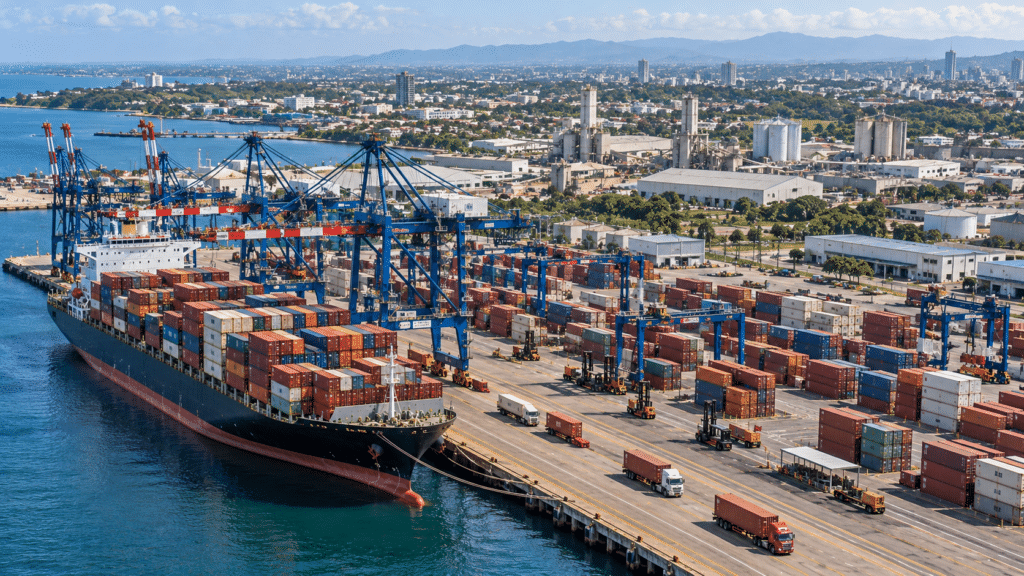
The sector benefits from the movement of goods through Dominican ports, airports, industrial facilities, distribution centers, and domestic transport networks. Export manufacturers need freight forwarding and customs services, while retailers and food distributors require warehousing and dependable delivery.
The country’s export expansion provides additional context. ProDominicana reported that merchandise exports reached US$14.65 billion in 2025, an increase of 13.4% from 2024. This created a larger flow of internationally traded goods, although export growth alone cannot establish the precise growth rate or profitability of logistics businesses.
Opportunities are not limited to owning trucks or warehouses. Companies can specialize in inventory management, freight documentation, temperature-controlled storage, customs brokerage, distribution software, and delivery services for industrial customers.
Business opportunities: Freight forwarding, warehousing, customs brokerage, trucking, cold-chain services, regional distribution, and supply-chain technology.
Risks: Fuel prices, infrastructure bottlenecks, port delays, maintenance expenses, and competition can reduce margins. Businesses must evaluate their routes, customers, and service requirements before investing in transport equipment or storage facilities.
For further reading, see Logistics Industry in the Dominican Republic.
3. Agriculture and Agro-Processing
Agriculture and livestock production expanded by 3.7% in 2025, following 4.9% growth in 2024. This represents continued real production growth, although the pace moderated.
Export data provide a second indication of the sector’s importance. Dominican agricultural exports exceeded US$3.59 billion in 2025, up 10.1% from 2024, according to ProDominicana. Cocoa, tobacco, bananas, coffee, and other agricultural products contributed to the country’s international sales.
The difference between these indicators matters. Agricultural GDP measures changes in domestic production, whereas export values can also rise because of higher international prices or a shift toward more valuable products. Both measures are useful, but they should not be treated as interchangeable.
Agro-processing offers opportunities to increase the value captured from agricultural output. Businesses can process, package, store, certify, and distribute products for domestic and export markets. Reliable sourcing and consistent quality are often as important as production volume.
Business opportunities: Cocoa processing, coffee roasting, food manufacturing, agricultural packaging, cold storage, irrigation systems, export preparation, and quality-control services.
Risks: Weather variability, crop disease, water availability, commodity-price fluctuations, and international food-safety requirements can affect returns. Exporters must verify the requirements of each destination market before entering into supply contracts.
For a dedicated analysis, see Agriculture Industry in the Dominican Republic and Agribusiness in the Dominican Republic.
4. Tourism, Hospitality, and Visitor Services
Tourism remains one of the Dominican Republic’s most important sources of international demand and foreign investment. Its economic contribution extends from hotels and restaurants to transportation, excursions, entertainment, retail, food distribution, and property management.
Hotels, bars, and restaurants recorded 3.5% real growth in 2025, compared with 9.5% in 2024. The slowdown indicates that the sector continued to expand, but at a considerably more moderate pace than in the previous year.
Investment figures tell a complementary story. Tourism accounted for 26.3% of foreign direct investment in 2025, the largest share among the sectors identified in ProDominicana’s annual figures. This suggests continued capital allocation toward tourism-related development, but investment commitments and real output growth measure different aspects of performance.
For entrepreneurs, opportunities can exist in supplying established hotels and resorts, operating specialized tours, providing transportation, and offering maintenance, cleaning, food, and technology services. These models can require different levels of capital and expose businesses to different risks than constructing a new hotel.
Business opportunities: Hospitality services, tour operations, airport transfers, food supply, hotel technology, cleaning, maintenance, and professional property management.
Risks: Seasonality, operating costs, international travel conditions, environmental pressures, and competition can affect profitability. Visitor growth alone does not guarantee higher margins, because spending per visitor, occupancy, length of stay, and the cost of delivering services also matter.
For more information, see Tourism Industry in the Dominican Republic.
5. Mining and Mineral Processing
Mining and quarrying recorded 4.6% real growth in 2025, reversing the 5.2% contraction registered in 2024. The rebound makes mining one of the faster-growing activities in the annual production comparison, although the two-year pattern does not establish a sustained upward trend.
The industry contributes through mineral extraction, processing, related transport, equipment procurement, and services for industrial operations. Its performance can be influenced by international commodity prices, production volumes, investment cycles, and the operational status of individual projects.
Mining also differs from service industries because commercial expansion can require substantial capital, specialized equipment, environmental approvals, and long development periods. As a result, opportunities for smaller businesses often arise in supplying established operators rather than developing mines independently.
Business opportunities: Industrial maintenance, equipment supply, engineering, mineral processing, specialized transportation, environmental services, and workplace safety systems.
Risks: Commodity-price volatility, environmental obligations, permitting requirements, high capital costs, and dependence on a limited number of large projects can create substantial uncertainty. A rebound in sectoral output should not be interpreted as evidence that all mineral projects are commercially viable.
For a dedicated industry overview, see Mining Industry in the Dominican Republic.
6. Energy and Renewable Power
Energy and water recorded 2.8% real growth in 2025, down from 7.0% in 2024. Although production growth slowed, the sector remains strategically important because electricity supply, reliability, and operating costs affect the competitiveness of nearly every other industry.
Foreign investment provides a second indicator of commercial activity. Energy received 23.8% of the Dominican Republic’s total FDI in 2025, making it the second-largest destination sector after tourism. The country’s investment figures therefore point to substantial capital allocation toward energy even though the latest annual production growth was moderate.
This distinction is important when assessing renewable energy. A solar or other electricity project may attract investment during construction, while its contribution to measured production emerges over a different period. Investment flows should not be confused with current electricity output.
Businesses may find opportunities in power generation, solar installation, industrial energy efficiency, equipment maintenance, storage, and systems that help commercial customers monitor and manage consumption.

Business opportunities: Solar project development, commercial rooftop installations, electrical engineering, battery systems, energy audits, maintenance contracts, and energy-management technology.
Risks: Project financing, grid connection, regulatory requirements, land availability, and the economics of selling electricity can determine whether a project succeeds. Investors should verify the applicable licensing, contractual, and technical requirements before committing capital.
For further reading, see Energy Industry in the Dominican Republic and Renewable Energy in the Dominican Republic.
7. Export Manufacturing and Free Trade Zones
Export manufacturing is an important business opportunity because it combines international market access, established industrial infrastructure, and a substantial employment base. However, its recent production growth was more moderate than the expansion recorded by financial services, transportation, and several other industries.
The Central Bank reported real growth of 1.8% in free-zone manufacturing and 1.4% in local manufacturing in 2025. Both activities expanded, but at a slower rate than in 2024.
Export performance was stronger than these production growth figures alone might suggest. Free-zone exports reached a record US$8.60 billion in 2025, according to ProDominicana. The difference between output and export-value growth can reflect prices, product mix, inventory movements, and the distinction between production and shipments.
The Dominican Republic’s free trade zones host manufacturers producing medical devices, pharmaceutical products, electrical components, tobacco products, apparel, and other goods. Their international orientation creates demand for industrial supplies, quality assurance, maintenance, packaging, and logistics.
Business opportunities: Contract manufacturing, packaging, industrial automation, quality-control services, specialized maintenance, freight forwarding, and regulatory compliance support.
Risks: International demand, trade policy, labor availability, customer concentration, and competition from other manufacturing locations can affect performance. Companies must also account for product-specific certification and regulatory requirements.
For the detailed sector analysis, see Manufacturing Industry in the Dominican Republic and Free Trade Zones in the Dominican Republic.
8. Construction and Real Estate-Related Services
Construction presents a more complicated picture than its investment and financing activity might initially suggest. The Central Bank reported a 1.8% real contraction in construction in 2025, following 2.1% growth in 2024.
At the same time, bank lending to construction increased by 20.1% in December 2025, according to the Central Bank’s annual economic report. This indicates an expansion in financing, but it does not establish equivalent growth in completed projects, construction output, or profitability.
Foreign investment also provides evidence of continued interest in the broader property market. Real estate accounted for 15.7% of FDI in 2025, although real estate investment and construction output are not identical measures.
These indicators suggest that construction-related opportunities should be evaluated selectively rather than assuming that the entire sector is expanding. Demand may differ substantially between residential development, commercial buildings, tourism-related properties, infrastructure, and renovation.
Business opportunities: Building materials, electrical and plumbing installations, engineering, equipment rental, property maintenance, renovation, and energy-efficient building systems.
Risks: Financing costs, project delays, construction-material prices, permitting, and the possibility of oversupply can affect returns. Developers should distinguish between projects supported by identifiable demand and those dependent primarily on future property-price appreciation.
For more information, see Construction Industry in the Dominican Republic.
Foreign Investment: Where Capital Is Flowing
The Dominican Republic received approximately US$5.03 billion in foreign direct investment in 2025, according to the Central Bank figures published by ProDominicana. This represented another annual record and an increase of approximately 11.3% over 2024.
The distribution of investment reveals which industries are attracting substantial capital, regardless of whether they have the highest short-term production growth.
| Sector | Share of 2025 FDI |
|---|---|
| Tourism | 26.3% |
| Energy | 23.8% |
| Real estate | 15.7% |
| Commerce and industry | 10.5% |
| Free trade zones | 8.7% |
| Mining | 6.7% |
| Financial sector | 3.4% |
| Other sectors | 4.9% |
Source: ProDominicana, Foreign Direct Investment Results for 2025.
Tourism and energy together accounted for just over half of the reported FDI total. Real estate attracted another substantial share, while commerce, industry, and free trade zones also received capital.
For investors, these figures help identify areas where major projects and financing activity are concentrated. They do not establish which sector offers the highest return on investment, because capital intensity, operating costs, project duration, and risk vary considerably.
Export Growth: Which Industries Are Expanding Internationally?
Merchandise exports reached US$14.65 billion in 2025, up 13.4% from 2024, according to ProDominicana. This is one of the clearest measurable signs of expansion in the Dominican Republic’s internationally oriented economy.
The increase was not confined to one product category. ProDominicana reported growth in agricultural products, medical instruments, plastics, iron products, cement, electrical components, and other merchandise.
The value of exports excluding unprocessed gold also increased, although at a slower rate than total exports. This distinction matters because commodity prices and individual large shipments can significantly influence the national total.
Agricultural exports exceeded US$3.59 billion, while free-zone exports reached US$8.60 billion. Together, these results demonstrate the importance of both agricultural production and industrial manufacturing to the country’s international trade.
Export growth creates opportunities beyond the companies shipping finished goods. Local suppliers may serve producers through packaging, maintenance, transport, storage, equipment, testing, and other services. However, the existence of growing exports does not guarantee that every supplier will benefit: companies must establish their competitiveness and secure actual customers.
What Is Driving Business Expansion?
Several forces help explain why these industries are attracting demand, capital, or additional production.
International Market Access
Exporters can serve customers beyond the domestic market, particularly in the United States and other international destinations. This creates opportunities for manufacturing, agriculture, logistics, and businesses that supply export-oriented companies.
Access alone is not sufficient. Firms must meet customer specifications, maintain quality, control costs, and comply with destination-market requirements.
Investment in Infrastructure and Production Capacity
Capital inflows can support new facilities, energy projects, tourism developments, and industrial expansion. Their effects may appear in investment statistics before they become visible in annual production data.
Businesses should therefore distinguish between a project announcement, capital actually invested, a facility under construction, and a completed operation generating revenue.
Domestic Demand and Business Financing
Domestic consumption supports commerce, transport, financial services, construction-related suppliers, and local manufacturing. Credit can help businesses finance equipment, inventories, and expansion.
However, lending growth should be assessed alongside repayment capacity, customer demand, and operating profitability. Higher borrowing does not necessarily mean that an industry is growing sustainably.
Productivity and Specialized Services
As businesses expand, they often require more sophisticated technology, logistics, maintenance, compliance, and financial management. This can create opportunities for smaller service providers even when they cannot compete directly with large industrial or tourism operators.
For many entrepreneurs, supplying an established growing business may be more practical than investing directly in the underlying industry.
How to Choose a Business Sector in the Dominican Republic
The best sector for a particular business depends on available capital, expertise, customer access, and risk tolerance. A high national growth rate is only a starting point.
Assess the Evidence of Demand
Determine whether demand is supported by recurring orders, signed contracts, established customers, or a demonstrable gap in the market. Industry growth statistics should inform the decision, not replace customer research.
Compare Entry Costs and Operating Requirements
A software service or specialized maintenance business may require a very different level of capital from a factory, hotel, or energy project. Assess equipment, labor, premises, insurance, financing, and regulatory requirements before comparing expected returns.
Verify Regulations and Incentives
Requirements differ across manufacturing, agriculture, energy, financial services, tourism, and construction. Companies should consult the relevant Dominican authorities and qualified local advisers to establish which permits, registrations, environmental approvals, and tax rules apply.
Evaluate Profitability, Not Just Growth
A growing industry can still be difficult to enter if competition is intense, operating costs are high, or customers have limited purchasing power. Compare margins, cash flow, customer acquisition costs, and the consequences of a downturn before committing capital.
Frequently Asked Questions
What is the fastest-growing business sector in the Dominican Republic?
Financial services recorded 7.5% real growth in 2025, the strongest performance among the major service industries in the Central Bank’s annual comparison. Mining and quarrying grew by 4.6%, while transportation and storage expanded by 4.1%. The answer changes depending on whether the comparison uses real output, exports, investment, or employment.
Which sectors attract the most foreign investment?
Tourism received 26.3% of the Dominican Republic’s FDI in 2025, followed by energy at 23.8% and real estate at 15.7%. These figures show where foreign capital was allocated, not which industries necessarily achieved the highest profitability.
Which industries have the strongest export opportunities?
Export manufacturing and agriculture have substantial established international sales. Free-zone exports reached US$8.60 billion in 2025, while agricultural exports exceeded US$3.59 billion. Logistics and industrial services can also benefit by supplying companies engaged in international trade.
Is construction a fast-growing sector?
Construction contracted by 1.8% in real terms in 2025, despite growth in construction lending. This mixed performance means that investors should evaluate individual projects and customer segments rather than assume that construction is expanding uniformly.
Are renewable energy and logistics promising business opportunities?
Both have credible expansion signals. Energy attracted 23.8% of FDI in 2025, while transportation and storage recorded 4.1% real growth. Nevertheless, project economics, regulation, financing, infrastructure, and customer demand determine whether a specific business will succeed.
How can investors verify whether an industry is growing?
Use the Central Bank’s real GDP-by-sector data as the starting point, then compare export figures from ProDominicana, foreign investment statistics, employment data, and relevant indicators of customer demand. Keep the periods and definitions consistent, and distinguish inflation-adjusted production from nominal sales and investment flows.
Conclusion
The Dominican Republic’s growth opportunities are distributed across industries with different economic drivers. Financial services and transportation recorded strong real output growth in 2025, while agriculture and tourism combined expanding activity with significant export or investment signals. Energy attracted substantial foreign capital, and export manufacturing remained important despite more moderate production growth. Construction, by contrast, demonstrated why financing and investment figures must be considered alongside actual output.
For entrepreneurs and investors, the most useful approach is to compare several indicators and identify where expansion creates a viable opening for a particular business. Real production growth, export demand, investment, employment, and financing each provide a different perspective. Together, they offer a more reliable foundation for evaluating opportunities than a single headline growth rate.